Buddhist Monk in Isolation (Mountain Snow)
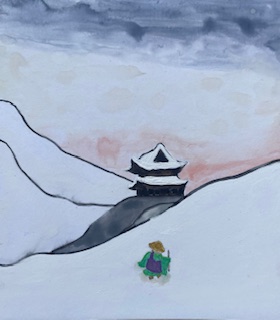
The artist Sawako Utsumi often focuses on religious and spiritual themes in her art. In this piece, once more, her attention turns to a Buddhist monk walking through a bleak mountain landscape. The snow is deep, the surroundings are austere, and a Buddhist temple stands in the distance. Yet, within this apparent isolation, there is a deeper spiritual presence, where the harshness of nature becomes an opportunity for contemplation, inner strength, and reflection.
Nichiren, the 13th-century Buddhist monk, said: “Those who believe in the Lotus Sutra are as if in winter, but winter always turns to spring.”
Nichiren wrote these words in 1275 in reference to the female lay Buddhist nun Myōichi. He knew that she was grieving the loss of her husband, suffering from illness, and enduring considerable hardship. Therefore, his words offered encouragement through the natural cycle of the seasons, using the certainty of winter giving way to spring as a metaphor for the struggles and possibilities of human existence.

Many remarkable attributes and mysteries surround Nichiren. After all, he survived a brutal execution attempt in which others might have perished. His life was marked by extraordinary conviction, including his prediction of the Mongol invasion and his willingness to challenge powerful individuals and established authorities despite the dangers. Such episodes reflect the spiritual determination that defined his Buddhist journey.
Nichiren also said: “If you seek enlightenment outside yourself, then your performing even myriad practices and good deeds will be all in vain.”
Hence, for Utsumi, winter and the apparent bleakness of nature offer solace. It is a time to reconcile oneself with the deeper beauty of this world, while looking beyond superficial appearances. Spring and summer witness the birth of countless animals and insects, yet nature also reveals the fragility and impermanence of existence. Many creatures have fleeting lives, and countless young animals perish before reaching maturity. For Utsumi, winter is therefore brutally honest about the realities of life. Its stillness encourages contemplation, allowing the observer to appreciate the beauty of existence without being distracted by its constant activity. In this sense, the silence of winter can become a spiritual refuge.
Equally, the Buddhist monk remains determined irrespective of the severity of winter or the loneliness of his surroundings. His attention is fixed on the journey ahead and the responsibilities that must be fulfilled, regardless of the obstacles. This resonates with the words of the Buddha: “Ardently do today what must be done. Who knows? Tomorrow, death comes.”
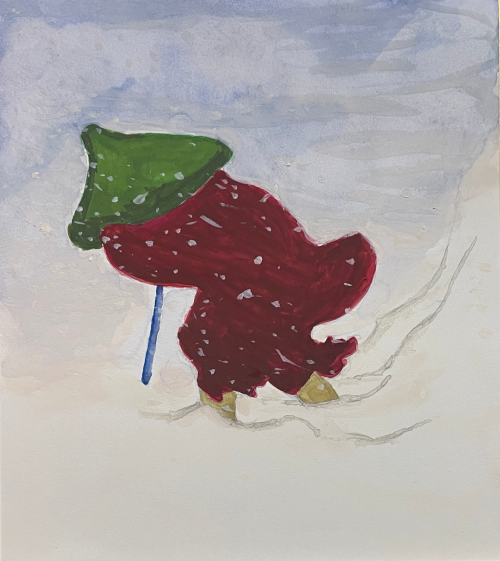
The monk understands that his journey is difficult and potentially dangerous. Yet, the impermanence of life makes his spiritual undertaking all the more meaningful. Rather than surrendering to the harshness of nature, he continues forward with discipline, humility, and resolve. His physical isolation also suggests another dimension of Buddhist contemplation: the importance of looking within oneself rather than seeking all answers in the outside world.
Overall, for Utsumi, winter is a season in which life comes alive spiritually because it represents the celebration of another year survived. The falling snow, imposing landscape, distant temple, and monk’s self-reliance create a fusion of natural beauty and spiritual determination. Beneath the apparent bleakness is a profound appreciation of existence, where hardship, impermanence, and perseverance become part of the same journey. Winter may conceal the promise of spring, but its own beauty and spiritual lessons should never be overlooked.
Written by Lee Jay Walker
https://fineartamerica.com/featured/buddhist-monk-in-winter-sawako-utsumi.html
https://fineartamerica.com/featured/buddhist-monk-in-deep-winter-sawako-utsumi.html

