Kukai and Shingon Buddhism

The contemporary Japanese artist Sawako Utsumi turns her creative focus toward the revered figure of Kūkai — the esteemed Buddhist monk, scholar, and founder of the Shingon school of esoteric Buddhism. Her work draws upon the spiritual gravity and sublime beauty of Mount Kōya (Kōyasan), a sacred mountain range in Japan that has long been a center of pilgrimage and devotion.
This mystical landscape, adorned with ancient Buddhist temples and the deeply spiritual Okunoin cemetery — where Kūkai is believed to rest in eternal meditation — serves as a place of Buddhist pilgrimage.
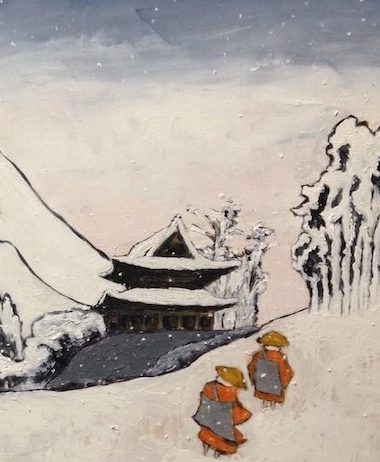
The BBC reports, “In 816 AD, a monk named Kukai wandered into the thickly forested slopes of Mount Koya (Koya-san) in Japan’s Wakayama Prefecture in hope of finding a suitable site to build a base for his newly founded Shingon sect of Esoteric Buddhism. He chose an 800m-deep valley surrounded by eight peaks, whose ridges resemble the petals of an eight-petaled lotus blossom. Twelve centuries and 117 temples later, Kukai’s spiritual wooded wonderland is a [Unesco World Heritage site].”
Kūkai (774–835), posthumously known as Kōbō Daishi, was a towering figure in Japanese spiritual history. In the ninth century, he founded the first Buddhist monastery on the sacred peaks of Mount Kōya (Kōyasan), establishing what would become the heart of Shingon Buddhism. Distinct from other schools within Japanese Buddhism, Shingon embraces an esoteric path shaped by Kūkai’s profound teachings — a vision that emphasizes ritual, mantra, and the deep unity between the cosmic and the human. His legacy continues to resonate across Japan, particularly in the serene, temple-dotted landscape of Kōyasan, where spiritual presence and natural beauty coexist in harmony.
Kukai said, “Do not seek to follow in the footsteps of the men of old; seek what they sought.”
Written by Lee Jay Walker
https://fineartamerica.com/featured/kukai-sawako-utsumi.html
 Sawako Art