English Working Class and Parish Apprentice – Aged Before Her Time
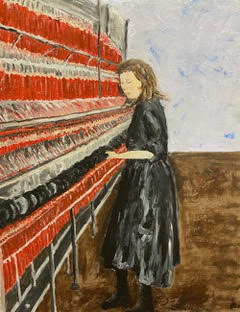
The contemporary Japanese artist Sawako Utsumi turns her gaze toward a sobering chapter in British history — the plight of the working class during the Industrial Revolution. Through her nuanced lens, Utsumi pays tribute to a generation whose suffering and endurance were foundational to modern Britain, yet are too often overlooked or simplified in today’s cultural narratives.
In the smoke-filled shadows of 19th-century industrial cities, children toiled for long hours, families endured grinding poverty, and life expectancy for many was shockingly low — in some cases, even comparable to, or worse than, enslaved populations in other parts of the world. These were not simply harsh working conditions; they were lives lived on the edge of survival, beneath the weight of exploitation and neglect.
Strikingly, echoes of that social divide still persist today. The native British working class continues to face significant disparities in both education and life expectancy when compared not only to the upper classes but also to many ethnic minority groups who, despite their own challenges, often outperform them academically. These enduring inequalities speak not only to past injustices but to a system that still fails to uplift its most disadvantaged.
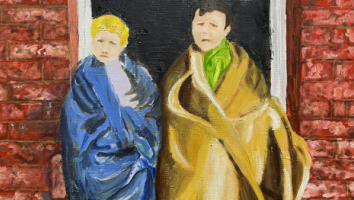
Utsumi’s art does more than recall history — it confronts the ongoing consequences of social deprivation with sensitivity and depth, reminding viewers that true progress must reckon with the forgotten faces of both past and present.
Child labor was the lifeblood of the Industrial Revolution — a stark counterpoint to the modern rhetoric of so-called “privilege” often directed at the indigenous British working class. Far from lives of comfort, generations of children were consigned to the factories, mines, and workhouses that powered Britain’s rise — their youth sacrificed at the altar of economic expansion.
As reported by The Independent, the research of Professor Jane Humphries of Oxford University sheds light on the brutal scale of this reality. During much of the 18th century, approximately 35% of working-class boys aged 10 were already part of the labor force. With the acceleration of industrialization, this figure rose sharply — reaching 55% between 1791 and 1820, and climbing further to a staggering 60% between 1821 and 1850.
The Independent reports, “The new research shows the extent to which Britain’s Industrial Revolution – the first in the world – was initially dependent, as far as the factories were concerned, on what were, in effect, child slaves. They weren’t paid – simply fed and given dormitory accommodation. In the 1790s, there were, at any one time, tens of thousands of such unpaid child workers.”

Friedrich Engels – concerning the nineteenth century – said, “THE GREAT MORTALITY AMONG CHILDREN of the working class, and especially among those of the factory operatives, is proof enough of the unwholesome conditions under which they pass their first years. These influences are at work, of course, among the children who survive, but not quite so powerfully as upon those who succumb...“
Intriguingly, the child laborer in Utsumi’s work appears far older than her years — a haunting testament to a childhood prematurely weathered by hardship. Through this subtle portrayal, Utsumi illuminates the profound toll inflicted not just on the body, but on the spirit: how youthful innocence was eroded, how dreams quietly withered under the relentless march of time and toil. These children, forced to surrender their fleeting joys, became unwilling cogs in the vast machinery of capitalism — bound to the unforgiving demands of the Industrial Revolution, their lives marked by servitude and sacrifice.
Written by Lee Jay Walker
https://fineartamerica.com/featured/english-working-class-workhouse-through-japanese-eyes-sawako-utsumi.htmlEnglish working-class workhouse through Japanese eyes
 Sawako Art